Lights, Camera, Aerosol: The Writers Getting Paid to Make Hollywood Look Real
There's a scene in almost every crime drama, coming-of-age movie, or gritty urban thriller where the camera pans across a wall covered in graffiti. For years — decades, really — those walls were dressed by props departments working off stock imagery and gut instinct, producing something that looked vaguely like graffiti the way a theme park looks vaguely like a real city. Writers across the country would clock it immediately: the wrong letter structure, the wrong color logic, the wrong everything. It was embarrassing. And Hollywood didn't seem to care.
That's starting to change.
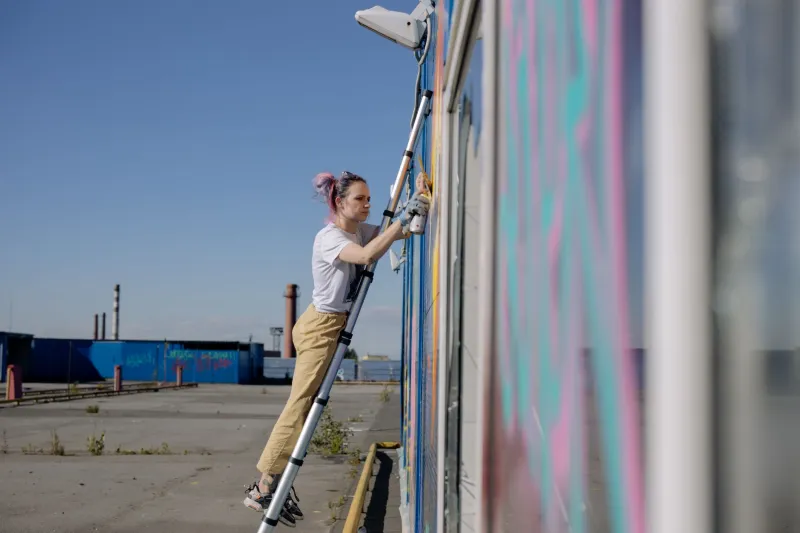
A quiet but real shift has been happening behind the scenes of major film and TV productions, where studios are increasingly reaching out to actual graffiti writers to consult, design, and execute work that holds up to scrutiny. The demand is real. So is the tension that comes with it.
The Problem With Fake Walls
Ask any writer who's watched their culture get Hollywood-ified and you'll get some version of the same story. "It looks like someone Googled 'graffiti font' and called it a day," says Deso, a New York-based writer with over twenty years in the game who's since transitioned into set work. "You've got bubble letters with no flow, colors that clash in ways nobody would actually do, and tags that don't belong to anyone. It's like putting a fake Basquiat in a museum and hoping nobody notices."
The issue isn't just aesthetic. For writers, graffiti carries a visual language — a grammar built over decades across cities, crews, and train lines. When that language gets mangled on screen, it flattens the culture into a costume. And when the camera lingers on that wall to signal 'danger' or 'decay,' it's not just inaccurate. It's doing real cultural and political work that writers have been pushing back against for a long time.
Productions that got it wrong didn't just look sloppy to those in the know. They reinforced tired stereotypes about urban spaces without actually understanding what they were representing.
When the Phone Calls Started Coming In
The shift toward authenticity — at least in terms of hiring practices — picked up noticeably in the last several years, driven partly by broader conversations about representation in Hollywood and partly by the simple fact that audiences are more visually literate than they used to be. Writers started getting calls from location scouts, art directors, and production designers who'd done their homework and knew that the real thing looked different from the prop version.
Los Angeles-based writer and muralist Krylon Kay remembers her first production inquiry landing in her DMs on Instagram. "They'd seen my work, they wanted something specific for a neighborhood scene, and they asked if I could come in and talk about it. I was skeptical at first — I'd heard enough stories about people getting their style used without any real compensation or credit."
She took the meeting anyway. What followed was a months-long negotiation that touched on everything from design approval to whether her name would appear in the credits. "That last part was a fight," she says. "They wanted to list it as 'set decoration.' I pushed for art direction credit because that's what it actually was. I was making decisions about the visual identity of a space. That's not decoration."
She got a partial credit. It's not a full victory, but she considers it progress.
What Gets Lost When the Culture Moves Indoors
Even the writers who've had mostly positive experiences on set are quick to name what disappears when graffiti moves from the streets to a controlled production environment. The risk, obviously. The illegality that shaped so much of the culture's aesthetic logic. But also the spontaneity, the conversation between writers, the way a wall evolves over time as different people add to it.
"On set, everything is approved," explains Deso. "You submit sketches. You get notes. You revise. And I get it — they have budgets and schedules and they can't have surprises. But graffiti has always been about surprises. It's a dialogue with the city, with other writers, with whoever walks by. None of that exists on a soundstage."
What can exist, he argues, is honesty about what it is. The best productions he's worked on don't try to simulate the street. They create something that's clearly informed by it — a stylized version that acknowledges its own artificiality while still feeling rooted in something real.
The worst ones, he says, want the aesthetic without the acknowledgment. They want the wall to feel dangerous and alive without crediting the culture that made it that way.
The Credit and Compensation Gap
For all the progress, the business side of these arrangements is still a mess. There's no standard rate for what a writer earns consulting on a production. There's no union framework that covers this kind of work in a way that makes sense for people coming from outside the traditional film industry pipeline. And the power dynamics are wildly uneven — a writer negotiating their first studio deal is up against lawyers and line producers who do this for a living.
"I've heard of people getting paid in exposure," says Krylon Kay, not hiding her disgust. "For a major studio production. Exposure. Like we don't know what our work is worth."
Some writers have started working with entertainment lawyers before signing anything. Others are leaning on networks of peers who've been through the process and can share what they've learned. There's a slow-moving collective knowledge base developing, passed around the way so much graffiti knowledge has always been passed around — person to person, city to city.
The question of creative control is equally thorny. Writers who come in with strong, distinctive styles sometimes find those styles diluted by the time the camera rolls, adjusted to fit a production designer's broader vision or a director's notes. Others have been given genuine latitude and produced work they're proud of. The difference often comes down to who's in the room and whether they actually understand what they're asking for.
A Conversation Worth Having
None of this is simple, and the writers who are doing this work aren't pretending it is. There are real tradeoffs. The money is often better than anything the street offers. The visibility can open doors. And there's something to be said for having writers in the room when decisions get made about how their culture is represented.
But the concern that Hollywood will take what it wants and leave the rest — take the aesthetic, skip the history, credit the studio and forget the writer — hasn't gone away. It's baked into the industry's relationship with every subculture it's ever borrowed from.
What's different now, maybe, is that writers are showing up to those conversations with their eyes open. They know what they bring. They know what it's worth. And they're getting better, slowly, at making sure the industry knows it too.
The walls are talking. Hollywood is finally starting to listen — even if it's still figuring out how to pay for the privilege.