Concrete Dreams: The Graffiti Writers Who Are Literally Building the Future of Skate Culture
There's a moment in a lot of graffiti writers' lives when the wall stops being enough. You've killed every freight spot in the county, your blackbook is three volumes deep, and somewhere in the back of your head a question starts forming: what if I could build the whole thing?
For a growing number of designers, architects, and urban planners with serious roots in writing culture, that question has become a career. Across the country — from Phoenix to Philadelphia, from Richmond to Riverside — a new wave of skate park projects is going up that looks nothing like the smooth, anonymous concrete slabs cities were dropping into neighborhoods back in the nineties. These spaces have personality baked into their structure. They have flow that feels less like civil engineering and more like a throw-up running the length of a freight car. They feel, in a word, written.
From the Blackbook to the Blueprint Table
The connection between graffiti and spatial thinking isn't accidental. Writers spend years training their eyes to read surfaces — the curve of a highway underpass, the flat plane of a handball wall, the negative space between letters on a rooftop. That kind of visual literacy translates. When you've spent a decade figuring out how to make a piece flow across an awkward, irregular surface, you develop instincts about space that no architecture school lecture is going to teach you.
Designers who came up writing talk about the work in terms that would feel completely at home in a crew session. It's about energy and movement. It's about how your eye travels. A good skate park, like a good piece, pulls you through it — there's a logic to the progression that feels inevitable once you're inside it, even if it took months of sketching to get there.
The blackbook itself is part of the pipeline. Multiple designers in this space describe going back to their old books not for nostalgia but for reference — pulling letter structures, color relationships, and compositional tricks directly into site plans and surface treatments. The muscle memory of the page is showing up in poured concrete.
What These Parks Actually Look Like
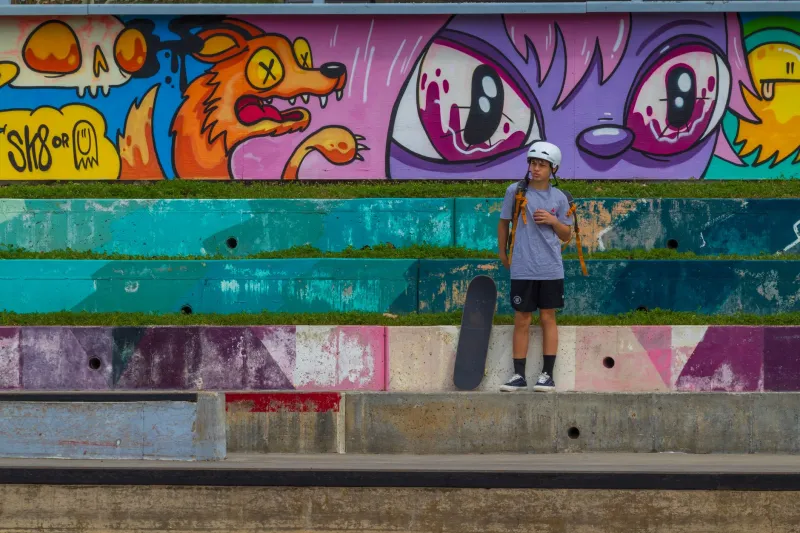
Forget the grey bowl with a chain-link fence around it. The parks coming out of this movement are dense with visual information. Transition walls carry full murals painted by writers who understand that the surface will be skated — meaning the art has to survive contact and still read at speed. Color blocking that looks purely aesthetic from the street doubles as wayfinding once you're rolling through the space. Lettering integrated into coping and ledge design gives familiar obstacles a second life as typography.
Some projects are going further, treating the entire park footprint as a single compositional canvas. The result is something that functions as infrastructure during the day and reads as a gallery installation from above — the kind of thing that looks completely different from a drone than it does from inside a bowl. Both views are intentional. Both are part of the design.
City planners working on these projects often describe a learning curve. The design vocabulary coming from writers doesn't always map cleanly onto standard municipal approval processes. When a designer explains that a particular wall angle is determined partly by how it'll carry color and partly by how it'll skate, that's not a conversation the parks department is always prepared to have. But the outcomes are winning people over. Communities that have historically had complicated relationships with city-built recreational spaces are showing up for these parks in ways that catch officials off guard.
The Politics of Handing Over the Keys
Let's be real about the tension here, because it's worth sitting with. The culture that built the visual language these designers are now deploying professionally is the same culture that cities spent decades criminalizing. The writers who developed the skills now being celebrated in RFPs and community design meetings learned those skills on walls they weren't supposed to touch, in yards they definitely weren't supposed to enter, under circumstances that got a lot of people locked up.
That history doesn't disappear because a city council approved a budget line. Designers working in this space talk about it with varying degrees of directness, but it's there in every conversation. There's pride in the legitimacy, and there's also a kind of irony that doesn't fully resolve — the awareness that the same aesthetic sensibility that once made you a target is now making you a commodity.
The writers who didn't make it to the blueprint table are part of that story too. The culture that's being celebrated in these park designs was built collectively, by people across every income level and background, a lot of whom are not getting consulting fees or design credits. How you feel about that probably depends on where you're standing.
Skaters Are Paying Attention
The skate community's response has been, by most accounts, enthusiastic — with caveats. Parks that look incredible but don't skate well are a real failure mode, and there are a few projects out there that prioritized the visual at the expense of the functional. Writers who skate understand the difference between a surface that photographs beautifully and one that actually works under a board, but not every designer in this space has both fluencies.
The parks that are landing well are the ones where the design team includes people who've spent real time on the concrete — not just looking at it. When the person making decisions about transition height and surface texture has a personal stake in whether the thing actually skates, you get different results than when the visual and functional design are siloed.
Skaters who grew up around graffiti culture tend to respond to these spaces with something that goes beyond the usual approval of a good park. There's a recognition happening — a sense that the space was made for them in a way that feels different from a city deciding to provide a recreational amenity. It was made by people who came from the same place.
What Comes Next
The pipeline is real and it's growing. Design programs are starting to take writers seriously as applicants. Community development organizations are actively recruiting people with graffiti backgrounds for public space projects. The skills that once had to be hidden are increasingly being listed on resumes.
What that means for the culture in the long run is genuinely unclear. Legitimacy has a way of changing things — sometimes for the better, sometimes in ways that sand down exactly the edges that made the thing worth celebrating in the first place. The writers building these parks are navigating that question in real time, in public, with city contracts and community expectations attached.
But walk through one of these new parks on a Saturday afternoon, watch a twelve-year-old drop into a bowl painted in a color palette that came straight out of a blackbook from 1993, and it's hard not to feel like something important is happening. The walls are still speaking. They just poured them themselves this time.