Your Tag Is Your Logo Now: How Graffiti Writers Turned Their Handstyle Into a Hustle
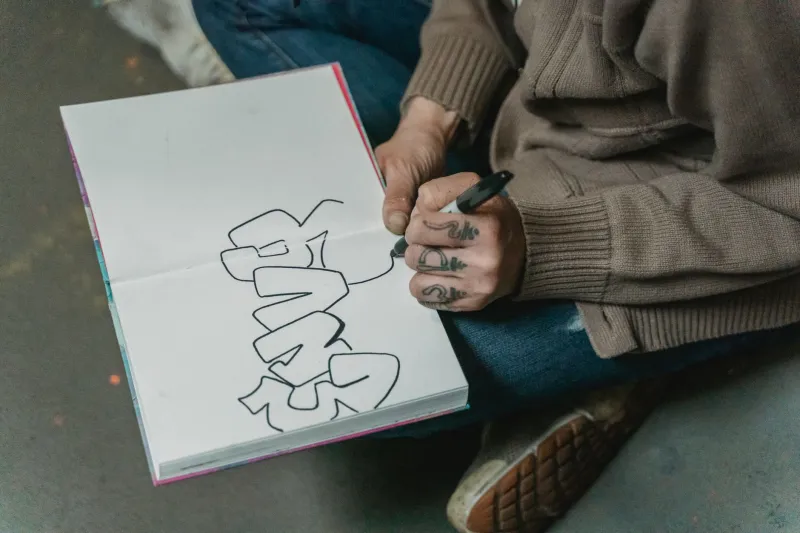
For most of graffiti's history, the handstyle was a private thing made public. You threw your name up, you moved on, you did it again. The repetition was the point. The consistency was the craft. Nobody was thinking about licensing deals or brand decks. Nobody needed to.
That math has changed.
Today, a writer with a tight, distinctive hand isn't just respected in the culture — they're potentially sitting on a design asset that creative directors, streetwear labels, and tech startups will actually pay for. The handstyle has become a portfolio piece. And the writers who figured that out early are eating well.
From Walls to Contracts
Ask any art director at a mid-size apparel brand what they're looking for and they'll use words like "authenticity" and "texture" and "organic." What they mean, more often than not, is graffiti energy without the legal liability. That's where writers with strong personal hands come in.
Take Reyes, a Los Angeles-based writer who spent fifteen years building one of the most recognizable throw-up styles in Southern California. He's not gallery-represented. He doesn't have an MFA. What he has is a handstyle so distinct that a major sneaker company flew him out to New York to hand-letter a limited-edition campaign. "They didn't want someone who could imitate graffiti," he says. "They wanted someone who actually was graffiti. That's a different thing."
This distinction matters more than ever. The market has gotten sophisticated enough to tell the difference between a designer doing a graffiti-inspired typeface and a writer whose hand developed over a decade of actual street practice. Brands that care about credibility — and the consumers who sniff out fakes — are increasingly chasing the real thing.
The NFT Detour (And What Writers Actually Took From It)
The NFT boom of 2021 was a weird moment for graffiti writers. On one hand, it felt like a natural fit — digital scarcity mapped neatly onto the limited-edition logic of the culture. On the other, a lot of writers watched outsiders profit from aesthetics they'd spent years developing, while the actual originators scrambled to catch up with wallets and minting fees.
But something useful came out of that chaos. Writers started thinking about their handstyle as intellectual property. Not in some corporate, lawyer-up way, but in a practical sense: this is mine, it has value, I should control how it moves through the world.
Maya, a Chicago writer who goes by Kess, minted a series of animated handstyle loops during that period. The sales were modest. What wasn't modest was the attention. "I got three brand inquiries off those drops," she says. "People started seeing my hand as a visual product. That shifted how I thought about everything."
Even as the NFT market cooled, the underlying lesson stuck. Writers who'd never considered themselves businesspeople started building out their own digital presence — not for clout, but for commerce.
Merchandise, Collabs, and the Independent Route
The gallery system was never designed for graffiti writers. It was designed for a different kind of artist, with a different kind of patience for institutional gatekeeping. Some writers made it work. Most didn't bother trying.
What's replaced it, for a growing number of writers, is a direct-to-consumer model that looks a lot like what independent musicians have been doing for years. You build your audience, you drop product, you keep the margin. The handstyle becomes the brand identity that ties it all together.
Detroit writer Skore has been running his own merch operation for three years. Hoodies, tees, limited-edition prints — all anchored by the same looping, compressed letterforms he's been putting on walls since his teens. "My tag is my logo," he says, without any irony. "I didn't hire a designer. I didn't go to art school. I just put in the reps until my hand was tight enough that people wanted it on their chest."
He's not alone. Across the country, writers are treating their personal aesthetic the same way a graphic designer treats a signature style — as something to be developed, protected, and strategically deployed.
What This Means for the Culture
Not everyone is comfortable with where this is headed. There's a real tension in the culture between the old-school ethic — you write because you have to, not because it pays — and the reality that writers, like everyone else, need to make rent.
Some veterans see the monetization wave as a natural evolution. Others worry it's flattening something that was never supposed to be marketable. "The handstyle was about saying 'I exist' on a wall that didn't want you there," says one New York writer who asked not to be named. "When it becomes a logo, does it still say the same thing?"
That's a fair question. It's also probably the wrong frame. The walls aren't going anywhere. The freight lines aren't going anywhere. The culture that produces the handstyle in the first place isn't going anywhere. What's shifting is the downstream economy — what happens after the tag dries.
And if writers are finally getting paid for something they've been perfecting for decades, that's not selling out. That's just the culture finally catching up to its own value.