Paint Before Dawn: Inside the Shadow Network Keeping Writers Stocked Across America
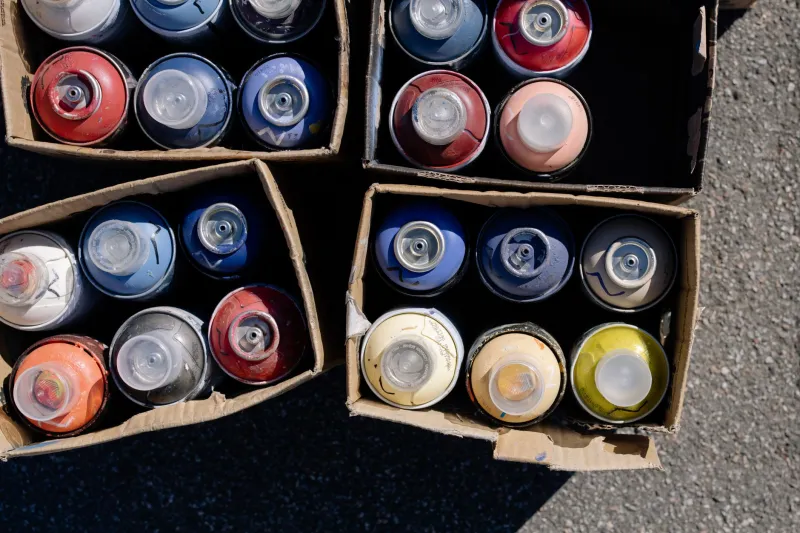
The can of Montana you're holding didn't get there by accident. Someone moved it. Someone knew someone who knew someone. And somewhere along the line, money changed hands in a parking lot, a back booth, or a DM thread that's since been deleted.
This is the part of graffiti culture that doesn't make it onto gallery walls or brand mood boards — the actual, physical infrastructure that keeps the underground scene running. The black market aerosol trade in America is older than most of the writers currently racking up pieces, and it's quietly more organized than anyone involved wants to admit.
The Supply Problem Nobody Talks About
Here's the thing about painting illegally in 2024: it's harder to get your hands on quality paint than it used to be. Loss prevention crackdowns at major hardware chains, anti-theft caps on aerosol cans in urban stores, and the steady creep of surveillance technology have made "racking" — shoplifting paint — significantly riskier than it was in the '90s. Some cities have gone further, restricting aerosol sales to minors or requiring ID to purchase spray paint at all.
Legal pressure didn't kill demand. It just pushed the supply chain underground.
"When the stores started locking up everything behind those plastic cases, the prices on the street went up," says a writer out of Chicago who's been active since the early 2000s and asked to be identified only as Sekt. "But the supply never actually dried up. It just got more organized. More deliberate."
That organization is what's fascinating. What could easily be dismissed as a chaotic, opportunistic gray market has, in many cities, evolved into something closer to a structured distribution network — with its own pricing conventions, reputation systems, and quality controls.
The Merchants Themselves
The suppliers operating in this space aren't monolithic. They range from individual writers who move small quantities on the side to supplement their income, to larger operations with actual inventory management and — in some cases — interstate distribution.
On the smaller end, you've got what insiders sometimes call "can runners" — writers or adjacent figures who source paint through a mix of racking, bulk purchase from out-of-state suppliers, and occasional importation of European brands not widely distributed in the US. They sell locally, move volume through trust networks, and keep things deliberately small to stay under the radar.
Further up the chain, though, things get more structured. Multiple sources in cities including Los Angeles, Philadelphia, and Houston described operations where suppliers maintain rotating storage locations — garages, storage units, sometimes commercial spaces with legitimate front businesses — and fulfill orders through encrypted messaging apps. Payment is typically cash or cryptocurrency. Deliveries are often coordinated to look like something mundane: a friend dropping by, a package left at a location.
"It's not glamorous," says a writer from South LA who goes by Prism and has purchased from black market suppliers for years. "It's just practical. You need paint, you know who to call, you make it happen. It's been like that forever."
The Specialty Market: Caps, Brands, and the Collector's Corner
Beyond the basics, a secondary market exists specifically for hard-to-find specialty items — nozzle caps imported from Spain and Germany, discontinued aerosol formulations that certain writers swear by, and limited-run colors from European brands that never made it to American distribution.
This is where the underground supply network gets genuinely interesting. Specific cap types — German imports known for their precision, certain vintage American nozzles that produce effects no current product replicates — trade almost like collectibles. Writers who've traveled internationally often come back with luggage stuffed with supplies, sometimes reselling at a significant markup.
"There's a whole thing around certain caps," says a New York-based writer who asked to remain anonymous. "Guys will pay real money for a bag of the right tips. It's not just about having paint. It's about having the right tools to do what you're trying to do."
European aerosol brands with superior pigmentation and pressure control — brands largely unavailable in standard US retail — command premium prices in this market. A can that retails for the equivalent of four or five dollars in Barcelona might move for three to four times that through underground channels in Brooklyn or Atlanta.
How the Network Evolves
What's notable about the current moment is how much the network has adapted to digital tools while simultaneously rejecting the visibility that digital tools usually create.
Transactions are arranged through encrypted platforms. Coded language is common — suppliers and buyers rarely discuss specifics openly, even in private messages. Reputation travels through personal networks rather than reviews. There's no Yelp for the underground aerosol trade, and that's entirely intentional.
Legal pressure has also pushed some of this activity across state lines. In states with stricter aerosol sale regulations, suppliers sometimes operate from neighboring states with looser laws, treating the whole thing like a distribution problem with a geographic solution.
"The law changes, the scene adapts," Sekt says. "It's always been that way. The culture is older than most of the laws trying to stop it."
The Ethics of the Economy
It would be easy to paint this entire ecosystem as purely criminal — and legally speaking, much of it is. But the writers and suppliers involved tend to describe it through a different frame: as a community sustaining itself against systems designed to shut it out.
"They don't want us in the stores, they don't want us on the walls, they don't want us anywhere," says Prism. "So we built our own thing. We always have."
That self-sufficiency is baked into graffiti's DNA. The culture has always operated outside the spaces designated for it, whether that's the sanctioned gallery or the licensed wall. The supply chain is no different — another adaptation, another workaround, another way the streets find a way to stay written.
The midnight merchants aren't going anywhere. As long as there are walls and writers who want to be on them, someone will figure out how to get them paint.