Steel, Speed, and Spray: The American Train Lines That Became Legends on Wheels
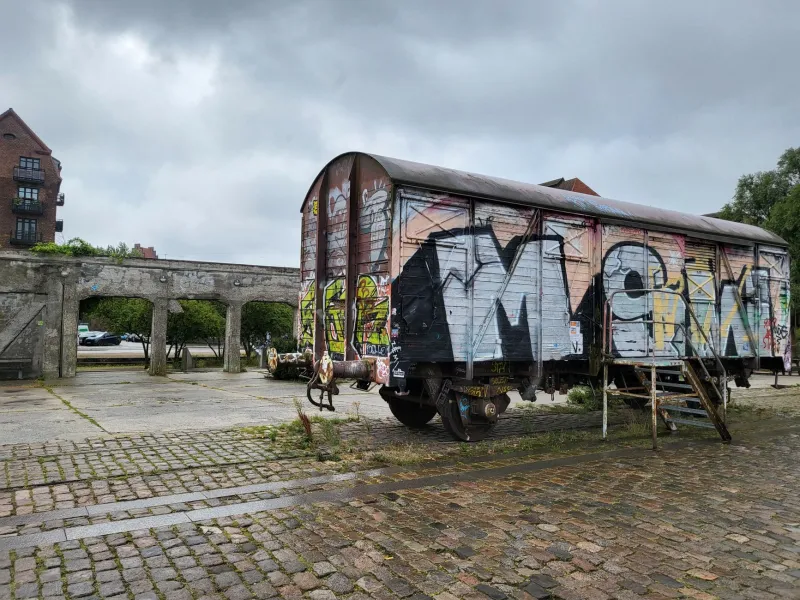
There is something almost mythological about a painted train. A whole car — sixty feet of steel — covered in letters that burn and bubble and breathe, screaming through a tunnel or gliding above a city street, seen for a moment by commuters who may not know what they're looking at but can't quite look away. The train was graffiti's first mass medium. Before the internet distributed style across the globe, the rails did it.
These are the lines that mattered most. The corridors where legends were made, where technique evolved, where the culture found its heartbeat and let it echo down the track.
1. The IRT No. 5 Line — New York City
If graffiti has a birthplace, this is the address. The No. 5 Lexington Avenue line, running through the Bronx and into Manhattan, was ground zero for the golden era of New York train writing — roughly 1971 through 1989, when the MTA's buff program finally caught up with the culture. Writers like Taki 183, Phase 2, and later Seen and Dondi made this corridor their proving ground. A whole car on the No. 5 wasn't just a flex — it was a declaration. The line's elevated sections through the Bronx meant pieces could be photographed in natural light, which is why so much of what we know about the era exists in visual record at all.
2. The IND A Train — New York City
The A train carried Langston Hughes to Harlem in a poem. It carried whole cars of graffiti to every borough in reality. The A's long run — from Far Rockaway to Inwood — gave writers maximum exposure. Getting up on the A meant your work traveled. Futura 2000, one of the most innovative stylists the culture ever produced, cut his teeth on this line, developing an abstract approach that looked like nothing else moving through the system at the time. The yards that fed the A were notoriously difficult to access, which made pieces that appeared on its cars that much more respected.
3. The 7 Train — Queens, New York
Known as the International Express for the immigrant communities it threads through — Jackson Heights, Flushing, Woodside — the 7 train was also an international express for graffiti style. Writers from Queens developed their own aesthetic sensibilities in dialogue with the cultural diversity of the neighborhoods they came from, and those sensibilities showed up on the 7's cars in pieces that felt different from what was happening in the Bronx or Brooklyn. The elevated portions of the line made it a moving gallery visible to entire neighborhoods.
4. The Chicago L — Red and Blue Lines
Chicago's elevated train system — the L — gave Midwest writers their own cathedral. The Red Line, running from Howard on the North Side to 95th Street on the South, passed through enough distinct neighborhoods to function almost as a sociological survey of the city. Chicago writers developed a style that was harder-edged than New York's, influenced by the city's gang culture and its own visual traditions. Crews like SWS and FUA built reputations on the L's cars through the eighties and nineties, and the footage and photos that survive from that era show a scene that was every bit as technically ambitious as what was happening on the coasts.
5. The LA Metro Blue Line
When Los Angeles launched its first modern light rail line in 1990, connecting Downtown LA to Long Beach, the city's writers were ready. The Blue Line's yards quickly became contested territory, and the cars that rolled out of them often wore the signatures of writers who had already built massive reputations on the freeways. LA's train writing culture had a different rhythm than New York's — less dense, more spread out, shaped by a city built for cars rather than commuters — but no less committed. Writers like Chaka and Eklips had already defined what LA style looked like on walls; the trains gave them a moving version of that canvas.
6. The BART System — San Francisco Bay Area
Bay Area Rapid Transit connected San Francisco to Oakland and beyond, and it connected two distinct graffiti scenes in the process. SF's Mission District writers and Oakland's crews brought different influences to the BART cars, and the resulting pieces reflected that tension and cross-pollination. BART's stainless steel exteriors were notoriously difficult to work with — paint adhesion was an issue — which meant writers had to adapt their materials and techniques. The cars that came out looking good came out looking very good.
7. The Miami Metrorail
Florida doesn't always get its due in graffiti history, but Miami's Metrorail was a significant chapter. The system, which opened in 1984, ran elevated through some of the city's most visually intense neighborhoods, and writers from Liberty City, Little Havana, and beyond brought a palette to its cars that reflected Miami's particular heat and color. The Cuban and Caribbean influences that ran through Miami's broader visual culture showed up in the lettering and character work that appeared on Metrorail cars through the late eighties and nineties.
8. The Caltrain Corridor — Northern California
Running from San Francisco down the Peninsula to San Jose, Caltrain's commuter rail corridor became a canvas for a generation of Bay Area writers who weren't getting up on BART. The freight connections along the line meant that writers who were active on freights had natural pathways into the Caltrain yards. The pieces that appeared on Caltrain cars through the nineties often reflected the broader freight aesthetic — bigger, cleaner, built for distance viewing — and some of the most technically refined work from that era came off this corridor.
9. The New York City No. 2 and 3 Lines — The Seventh Avenue IRT
If the No. 5 was the proving ground, the 2 and 3 lines were the arena. Running through Harlem and Brooklyn, these lines connected communities where graffiti culture was deeply embedded in everyday life. The writers who came up around these lines were painting in neighborhoods where their work was read by people who understood exactly what they were looking at — which raised the stakes and the standards simultaneously. Blade, who claimed to have painted more whole cars than any writer in history, was deeply connected to this corridor.
10. The PATH Trains — New York/New Jersey
The Port Authority Trans-Hudson trains connecting Manhattan to New Jersey might seem like an unlikely entry, but the PATH system holds a specific place in graffiti lore. The yards were accessible, the cars ran through tunnels that preserved pieces longer than outdoor exposure would allow, and the cross-state nature of the line meant that writers from New Jersey — a scene that has never gotten enough credit — had a vehicle for their work to reach New York audiences. Writers from Jersey City and Newark who built reputations on PATH cars were operating in genuine dialogue with the New York scene without being subsumed by it.
The trains are largely clean now. Buff programs, surveillance cameras, and zero-tolerance policies have made train writing exponentially more difficult and consequential than it was in the seventies and eighties. But the culture those rolling galleries produced — the styles, the techniques, the visual DNA that runs through everything from commercial lettering to contemporary mural work — is still very much in motion.
The trains moved. The art stayed.
And somewhere, right now, someone is planning their next move with a marker and a map, carrying forward a tradition that started in a New York City yard half a century ago and never really stopped rolling.