Beyond the Can: The Rogue Chemists Reinventing What Graffiti Paint Can Actually Do
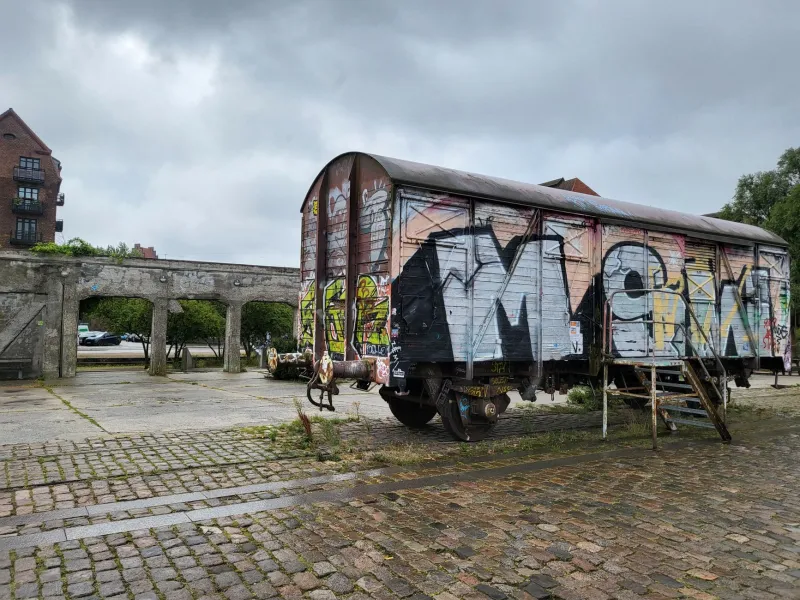
Photo: ubahnverleih, CC0, via Wikimedia Commons
Somewhere in an industrial district outside of a mid-sized American city, a writer who goes by the name Ferric is standing over a modified paint mixer, adjusting the viscosity of a custom formula he's been developing for eight months. He won't tell me exactly what's in it. He will tell me that when he finally gets it right, it'll run exactly as far as he wants it to, in exactly the weather conditions that currently make his preferred technique unreliable, and that no commercial manufacturer is even close to offering something like it.
"The cans are built for the average," he says, without looking up from the mixer. "I'm not interested in the average."
This is the frontier that doesn't get talked about much outside of very specific circles — the material science underground of graffiti writing, where obsessive experimenters are treating paint chemistry the way an earlier generation treated letterforms: as a problem worth solving from scratch.
Why Commercial Paint Keeps Missing the Point
Let me be clear about something: modern aerosol paint is genuinely impressive. The gap between what was available in the eighties and what you can buy at a specialty graffiti shop today is enormous. Pressure consistency, color range, cap compatibility, surface adhesion — all of it has improved dramatically.
But here's the thing about the commercial market: it's optimized for a version of graffiti writing that prioritizes clean, controllable output. That's what sells to the largest number of buyers, including the growing population of legal muralists and commissioned artists who represent an increasingly important revenue stream for manufacturers. The experimental, boundary-pushing end of the practice — the writers who want paint that does things it's not supposed to do, in conditions it's not supposed to work in, on surfaces it's not designed for — that market is too small and too specific to drive product development.
So those writers are doing it themselves.
The Industrial Sourcing Pipeline
One of the less-discussed aspects of graffiti's material culture is how extensively writers have always pulled from industrial supply chains. Before the specialty graffiti paint market existed, writers were using whatever they could find — hardware store enamel, automotive lacquer, industrial coatings meant for factory floors and shipping containers. Some of those materials produced effects that commercial graffiti paint has never successfully replicated.
That tradition never went away. There's an active underground network of writers who source materials from industrial suppliers, auto body supply houses, and specialty coating manufacturers — places that sell to contractors and manufacturers rather than artists. The materials are often cheaper, sometimes dramatically more durable, and frequently capable of effects that consumer aerosols can't touch.
One writer, who works primarily on freight and asked not to be identified, sources a specific industrial primer that bonds to weathered steel in ways that standard aerosol simply won't. "I've had pieces on cars for six years. The paint that's supposed to last is gone. Mine's still there." He's spent considerable time reverse-engineering why it works the way it does, and using that understanding to modify how he applies it.
The Custom Formula Builders
Beyond sourcing, there's a smaller but more intense community of writers who are actually formulating their own materials. This ranges from relatively straightforward modifications — adjusting the viscosity of existing products, creating custom color mixes, experimenting with additives that affect drying time or surface texture — to genuinely complex chemistry involving pigment grinding, binder selection, and pressure-fill operations that are, to put it gently, operating outside normal safety parameters.
Ferric, who has a background in industrial coatings from a previous career, is on the more sophisticated end of this spectrum. His current project is a formula designed specifically for the kind of controlled drip work he's been developing — a technique that requires paint to flow at a very specific rate that changes based on temperature. "Commercial paint gives you one behavior. I need a range of behaviors. So I build the range."
The knowledge that makes this possible is increasingly accessible. Chemistry forums, industrial coating databases, and a loose network of writers who share technical information through encrypted channels have created something like an open-source material science community operating entirely outside the commercial ecosystem.
What They're Actually Achieving
So what does all this experimentation actually produce? The honest answer is: some failures, some marginal improvements, and occasionally something genuinely remarkable.
The most compelling outcomes tend to be in durability and environmental performance. Writers working in extreme conditions — harsh winters, intense sun, coastal salt air, surfaces with heavy contamination — have developed material approaches that outperform commercial options significantly. Some of the freight work produced with industrial-sourced materials has survived conditions that would have destroyed standard aerosol pieces within a season.
On the aesthetic side, the most interesting results are coming from writers experimenting with finish quality — developing formulas that produce surface textures and light interactions that commercial paint doesn't offer. Metallic effects that go beyond what's in any can. Matte finishes with unusual depth. Color interactions that shift under different lighting conditions.
None of this is without risk. Some of the materials being used carry real health hazards, and the improvised application methods that come with DIY chemistry aren't always safe. This is worth saying plainly: the experimental material culture of graffiti writing operates in spaces where the normal safety infrastructure of commercial products doesn't apply, and the writers doing it seriously tend to be both more aware of those risks and better equipped to manage them than the casual observer might assume — but the risks are real.
The Philosophy Behind the Experiment
What strikes me most about the writers deep in this material experimentation isn't the technical knowledge — it's the philosophy driving it. There's a consistent refusal to accept that the tools available are the tools that should exist. A conviction that the material culture of the practice should evolve as fast as the visual culture does.
In a lot of ways, it's the same impulse that drove writers to modify caps, to figure out how to get paint to do things the manufacturer never intended, to treat every limitation as a problem worth solving. The chemistry just got more serious.
The manufacturers will catch up eventually. They always do — they watch what's happening in the culture and find ways to productize it. But by the time they do, the experimenters will already be three problems ahead, mixing something new in a building that doesn't have a sign on it, asking what paint should be able to do next.